Columns

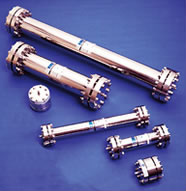
YMC Conventional prep columns are available in a wide range of column sizes packed from a variety of YMC*Gel for customers purposes.
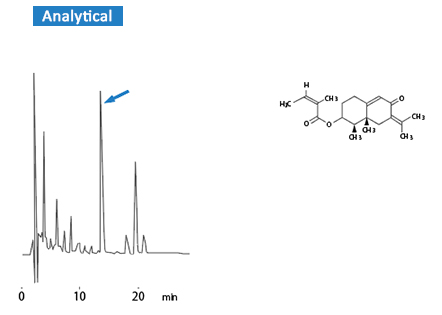
| Column | YMC-Pack ODS-A (5 µm, 120 Å) 250 X 4.6 mmI.D. |
|---|---|
| Eluent | acetonitrile/water (65/35) |
| Flow rate | 1.0 mL/min |
| Pressure | 12 MPa |
| Detection | RI |
| Injection | 50 µL (1 mg) |
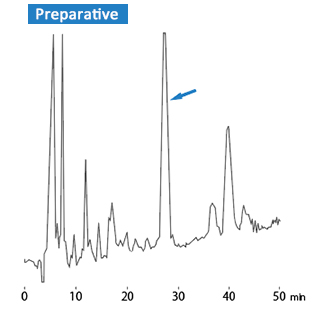
| Column | YMC-Pack ODS-A (5 µm, 120 Å) 250 X 20 mmI.D. |
|---|---|
| Eluent | acetonitrile/water (65/35) |
| Flow rate | 9.9 mL/min |
| Pressure | 18 MPa |
| Detection | RI |
| Injection | 1 mL (20 mg) |
| Packing material | Phase | Particle size (µm) |
Pore size (Å) |
Usable pH range | Product List |
|---|---|---|---|---|---|
| Triart C18 | C18 | 5 | 120 | 1-12 | Product List |
| Triart C18 ExRS | C18 | 5 | 80 | 1-12 | Product List |
| Triart C8 | C8 | 5 | 120 | 1-12 | Product List |
| Triart Phenyl | Phenyl | 5 | 120 | 1-10 | Product List |
| Triart PFP | Pentafluorophenyl | 5 | 120 | 1-8 | Product List |
| Triart Bio C18 | C18 | 5 | 300 | 1-12 | Product List |
| Triart Bio C4 | C4 | 5 | 300 | 1-10 | Product List |
| Packing material | Phase | Particle size (µm) |
Pore size (Å) |
Usable pH range | Product List |
|---|---|---|---|---|---|
| Pro C18 | C18 | 5 | 120 | 1-8 | Product List |
| Hydrosphere C18 | C18 | 5 | 120 | 1-8 | Product List |
| Pro C18 RS | C18 |
5 | 80 | 1-10 | Product List |
| Pro C8 | C8 | 5 | 120 | 1-8 | Product List |
| Pro C4 | C4 | 5 | 120 | 1-8 | Product List |
| Packing material | Phase | Particle size (µm) |
Pore size (Å) |
Usable pH range | Product List | |
|---|---|---|---|---|---|---|
| ODS | ODS-A | C18 | 5 | 120, 200, 300 | 2-7.5 | Product List |
| ODS-AQ | C18 | 5 | 120, 200 | 2-7.5 | Product List | |
| ODS-AM | C18 | 5 | 120 | 2-7.5 | Product List | |
| ODS-AL | C18 | 5 | 120 | 2-7.5 | Product List | |
| Other Reversed Phase | C8 | C8 | 5 | 120, 200, 300 | 2-7.5 | Product List |
| C4 | C4 | 5 | 120, 200, 300 | 2-7.5 | Product List | |
| TMS | C1 | 5 | 120 | 2-7.5 | Product List | |
| Ph | Phenyl | 5 | 120 | 2-7.5 | Product List | |
| CN | Cyanopropyl | 5 | 120, 300 | 2-7.5 | Product List | |
| YMC Carotenoid | C30 | 5 | - | 2-7.5 | Product List | |
| Normal Phase | SIL | Silica | 5 | 120 | 2-7.5 | Product List |
| SIL-06 | Silica | 5 | 60 | 2-7.5 | Product List | |
| NH2 | Aminopropyl | 5 | 120 | 2-7.5 | Product List | |
| Diol-NP | Diol | 5 | 60, 120 | 2-7.5 | Product List | |
| Polyamine II | Polyamine | 5 | 120 | 2-7.5 | Product List | |
| Packing material | Chiral selector | Particle size (µm) |
Product List | |
|---|---|---|---|---|
| Immobilized type | Amylose-SA | Amylose tris(3,5-dimetylphenylcarbamate) | 5 | Product List |
| Cellulose-SB | Cellulose tris(3,5-dimetylphenylcarbamate) | 5 | Product List | |
| Cellulose-SC | Cellulose tris(3,5-dichlorophenylcarbamate) | 5 | Product List | |
| Cellulose-SJ | Cellulose tris(4-methylbenzoate) | 5 | Product List | |
| Cellulose-SZ | Cellulose tris(3-chloro-4-methylphenylcarbamate) | 5 | Product List | |
| Coated type | Amylose-C Neo | Amylose tris(3,5-dimetylphenylcarbamate) | 5 | Product List |
| Cellulose-C | Cellulose tris(3,5-dimetylphenylcarbamate) | 5 | Product List | |


