Columns

The combination of ultra pure silica and unique selectivity leads to a stationary phase that fulfills the relevant requirements of HPLC users.
Minimal metal content and very low concentrations of residual silanols make this an ideal phase for the analysis of basic pharmaceuticals and chelating compounds even under LC-MS conditions (e.g. separation in non-phosphate buffered systems).
In addition the possibility to separate polar compounds under highly aqueous mobile phase conditions without loss in retention, plate counts and peak performance greatly enhances the versatility of Hydrosphere C18.
These characteristics will allow Hydrosphere C18 to be used for a wide range of applications of compounds with polar functional groups. 2 µm particle size columns YMC-UltraHT series are specifically designed for high-speed and high throughput analysis.
| SPECIFICATION | |
| Particle size | 2 µm, 3 µm, 5 µm |
|---|---|
| Pore size | 120 Å |
| Carbon contents | 12% |
| Usable pH range | 2-8 |
Retention time of nucletic acid bases is compared before and after one night standing in 100% water. Hydrosphere C18 provides stable retention and remarkable reproducibility while conventional ODS has declining retention when we compare retention time of adenine in the initial chromatograms with that of chromatograms generated the next day.
After the operation, the column was stored overnight (about 15 hours)
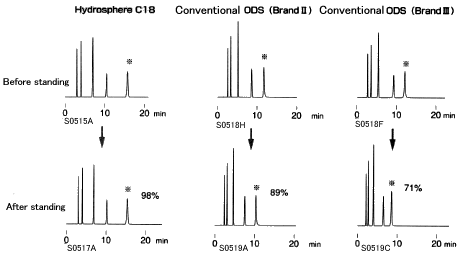
| Column | 150 X 4.6 mmI.D. |
|---|---|
| Eluent | 20 mM KH2PO4-K2HPO4 (pH 6.9) |
| Flow rate | 1.0 mL/min |
| Temperature | 37°C |
| Detection | UV at 254 nm |
Chromatograms of Hydrosphere C18 and conventional ODS are compared by using a test mixture containing compounds that have different properties.
The chromatograms show that Hydrosphere C18 has a different separation profile of elution sequence or retention time or resolution etc. from conventional ODS.
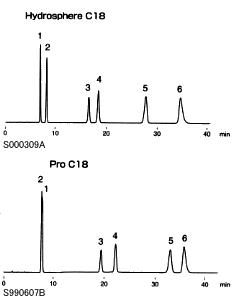
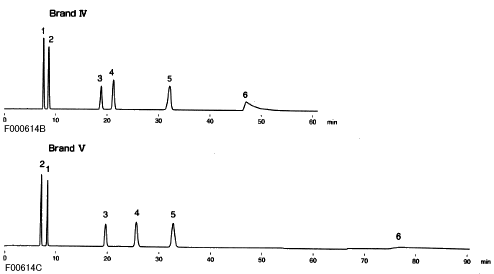
| Column | 150 X 4.6 mmI.D. |
|---|---|
| Eluent | 20 mM KH2PO4-K2HPO4 (pH 6.9)/methanol (35/65) |
| Flow rate | 1.0 mL/min |
| Temperature | 37°C |
| Detection | UV at 254 nm |
Hydrosphere C18 allow us to shorten the analysis time by 20% compared with conventional ODS for the separation of highly hydrophobic compounds.
Antioxidants
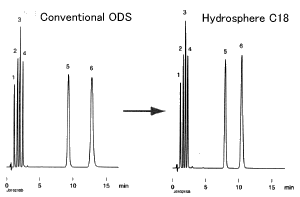
| Column | 50 X 4.6 mmI.D. (3 µm, 12 nm) |
|---|---|
| Eluent | acetonitrile/methanol/5% acetic acid (35/35/30) |
| Flow rate | 1.0 mL/min |
| Temperature | 30°C |
| Detection | UV at 280 nm |
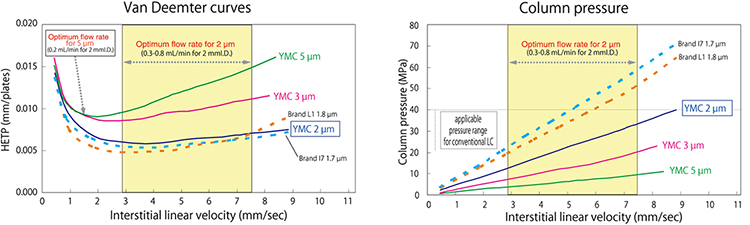
Hydrosphere C18 with 2 µm particle size is available, and it realized column efficiency with 60% less than column pressure as same as that of sub-2 µm used for UHPLC.
Ultra fast analysis can be performed by using Conventional LC systems, since Hydrosphere C18 can use in lower pressure than that in sub-2 µm. Columns with 3 mmI.D., which can be applied to conventional systems are available.
| Column | 50 X 2.0 or 2.1 mmI.D. |
|---|---|
| Eluent | acetonitrile/water (60/40) |
| Temperature | 25°C |
| Sample | Butyl benzoate |


